

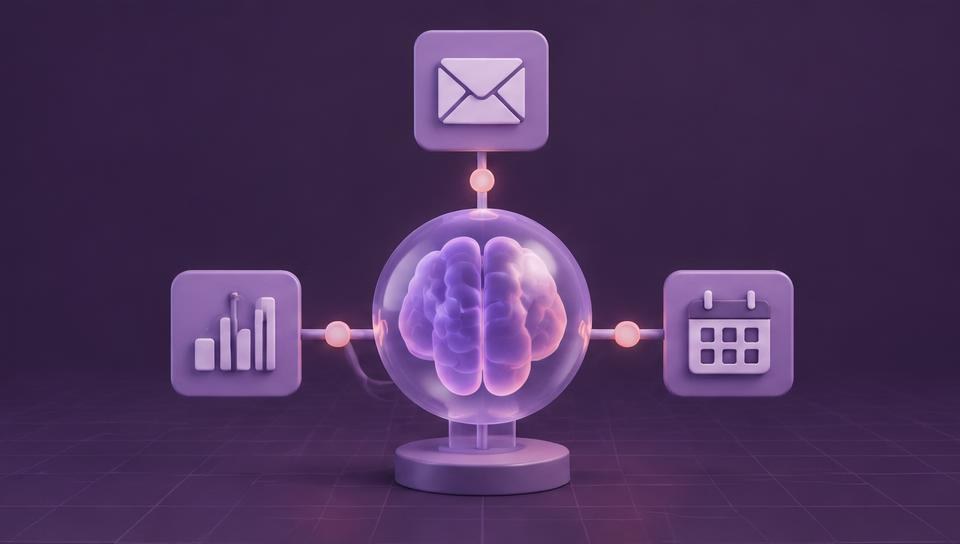
For two years, the term AI agent has been everywhere in B2B marketing, often used loosely to describe any feature that includes a language model. Yet the difference between an AI assistant that writes an email on request and an AI agent that runs a complex task end to end (researching accounts, qualifying signals, personalizing a message, sending it and adjusting the next step based on the reply) is fundamental to understanding what these tools can really do today. This guide explains what an AI agent is in B2B marketing, the use cases that actually work in 2026, the ones that are still mostly marketing talk, and how to roll them out without losing relevance or compliance.
What is an AI agent in B2B marketing?
An AI agent is a system that can plan and carry out a sequence of actions to reach a goal, making intermediate decisions without human input at every step. Unlike a generative AI assistant that answers a one-off request (write me this email), an AI agent orchestrates several tools and steps: it can query a database, cross-check signals, generate content, send it through a channel, observe the result and adapt its next action accordingly.
In B2B marketing, this ability to orchestrate changes what can be automated. Work that used to need a human at every step (identifying a relevant account, checking whether it qualifies, personalizing a message, choosing the right channel, scheduling the send) can now be carried out by an agent that follows defined logic, with human checkpoints only at the critical steps.
The key distinction in 2026: an AI assistant answers a request, an AI agent pursues a goal. The first writes an email if you ask it to. The second identifies that an account deserves outreach, writes a message suited to the context, sends it at the right time and adjusts what comes next based on the reply.
Why AI agents are emerging now in B2B marketing
Three factors are converging in 2026. First, language models have improved enough to produce credible personalized text at scale, without the obvious errors that gave away AI-written emails two years ago. Second, inference costs have fallen, which makes it economically viable to run an agent across thousands of accounts rather than a handful of pilot cases. Third, integrations between marketing tools (CRM, data enrichment, sending tools, social platforms) have become standardized enough for an agent to orchestrate several systems without costly custom development.
This convergence explains why most B2B prospecting and marketing automation tools now include an agent layer, when it was only a marginal feature eighteen months ago.
Read also: AI prospecting, what AI agents actually change in salesAI agent use cases in B2B marketing that actually work
Account research and qualification
An AI agent can analyze a list of target accounts, cross-check firmographic criteria (size, industry, technology used) with intent signals (funding round, hiring, a decision-maker's job change, engagement with content) and produce a prioritized list of accounts to contact first. This task, which used to take an SDR several hours a week, now takes a few minutes, as long as the criteria are well defined.
Personalizing messages at scale
Beyond inserting variables (first name, company), an AI agent can analyze a prospect's LinkedIn profile, their recent activity and their company's news, then write an opening message that references a specific, relevant detail. This kind of contextual personalization used to be reserved for strategic accounts handled by hand by the best salespeople. It matters all the more when it relies on a real signal: on Jova campaigns triggered by hot signals, the reply rate is over 20%, compared with under 10% for classic cold outreach.
Orchestrating adaptive multichannel sequences
An AI agent can run a sequence that adapts in real time: if a prospect opens an email but does not click, the agent adjusts the next message; if they engage with one of the company's LinkedIn posts, the agent triggers direct outreach instead of waiting for the next scheduled step. Jova applies this principle to its multichannel sequences: intent signals detected on LinkedIn automatically trigger the most relevant action, without the user having to watch every prospect by hand.
Read also: how Jova's intent signals workContinuous data enrichment and updates
B2B contact databases go stale fast: job changes, company changes, new email addresses. An AI agent can continuously check and enrich the contact records in a CRM by cross-checking several data sources, with no manual work. This ongoing maintenance prevents the gradual decline in data quality that affects B2B CRMs left without updates.
| Use case | Maturity in 2026 | Estimated time saved |
|---|---|---|
| Account research and prioritization | Mature | High |
| Contextual message personalization | Mature | High |
| Adaptive multichannel orchestration | Growing | Medium |
| Continuous data enrichment | Mature | High |
| Long-form content writing | Partial, human review required | Low |
| Autonomous negotiation or closing | Immature | Not recommended |
What AI agents still do not do well
Despite the progress, several limits remain in 2026, and you should know them before handing an entire task to an agent.
Understanding relationship context
An AI agent can analyze structured data and public text, but it has no access to the implicit relationship context an experienced salesperson carries: a remark made on a previous call, internal politics at the customer, something left unsaid in an email. On strategic accounts with long, complex sales cycles, humans remain essential for these nuances.
The risk of noticeable over-automation
B2B prospects in 2026 are increasingly quick to spot generic AI-generated messages. A poorly configured agent that sends messages that look personalized but sound artificial damages the sender's reputation faster than a less sophisticated but genuine manual message. The quality of the agent's setup, not the technology itself, makes the difference.
High-stakes or low-volume decisions
For strategic six- or seven-figure deals, where every interaction counts, handing personalization or timing to an autonomous agent remains risky. AI agents excel at volume (hundreds or thousands of accounts handled with consistent logic), not on the few accounts where one error of judgment can cost a major contract.
The rule of thumb adopted by the most mature B2B marketing teams in 2026: AI agents handle volume and repetition, humans handle exceptions and strategic accounts. An agent that works 500 tier 3 accounts frees up time for the team to focus on the 20 tier 1 accounts that deserve individual attention.
How to bring AI agents into your B2B marketing strategy
Start with one measurable task
The temptation is to automate the whole funnel at once. The approach that works is the opposite: pick one precise task (for example, qualifying inbound leads or personalizing first prospecting messages), measure its performance before and after, then gradually widen the agent's scope once trust is established.
Read also: lead scoring, how to decide who to contact firstKeep a human checkpoint on sensitive steps
The most effective teams set up their agents with human approval on high-impact actions: the first message to a strategic account, the decision to follow up after an explicit no, or any communication on sensitive topics (pricing, contracts). On those specific steps, the agent prepares and the human approves.
Measure quality, not just volume
An agent that handles ten times more accounts is only useful if contact quality does not drop proportionally. Track reply rate, meeting conversion rate and complaint or unsubscribe rate alongside the volume handled. Higher volume paired with a falling reply rate points to a poorly configured agent rather than a real productivity gain.
Follow the same data protection and platform rules
An AI agent that automates prospecting is subject to the same data protection obligations as any other marketing activity, and those rules vary by country. In the EU, under GDPR, B2B prospecting usually relies on legitimate interest, with a right to opt out and limited data retention. Likewise, LinkedIn's quotas and rules of conduct apply in full: an agent that sends abnormal volumes gets detected and penalized like any other non-compliant automated behavior.
Source: LinkedIn Help: prohibited software and extensions
What AI agents change for the CMO: choosing the right priorities
For a CMO or marketing leader, the first decision is to identify the team's bottleneck, rather than comparing agents on the number of features they advertise. If acquisition lacks leads, a prospecting agent addresses the problem. If leads exist but convert poorly, the priority may be a qualification agent or a virtual SDR that answers questions and passes requests on to a salesperson.
Other families of agents meet different needs: a content agent adapts posts to the audience and the channel, while an analytics agent queries data to surface insights on campaign performance. The point is not to deploy all these families at once, but to pick the one that acts on the task holding back growth.
Before committing budget, the CMO can check what sets offers apart beyond their promise of autonomy: access to the company's own data, the ability to audit decisions after the fact, whether the team's corrections are taken into account, and the billing model. An agent that starts from scratch at every interaction is not managed like one that takes corrections into account; likewise, cost should be weighed against the value created and actual usage.
Organizing the team to manage AI agents
A rollout works better with a salesperson or marketer acting as the point person who validates the pilot's results. This role lets you fit the agent into an existing process without disrupting the organization: the point person reports the errors they see and documents failure cases so the agent's prompts and rules can be adjusted.
Widen the scope only after validating results over at least 4 to 6 weeks. For the marketing leader, this feedback helps decide where to reallocate the time saved: strategy, creativity, customer relationships and deeper qualification conversations. The organizational change is not about replacing the team, but about shifting its attention from repetitive execution to these activities.
B2B marketing tools with built-in AI agents in 2026
Jova includes an agent layer for detecting LinkedIn intent signals: the agent continuously monitors interactions (likes, comments, job changes) and automatically triggers the most relevant outreach sequences, with built-in enrichment and scoring, without the user having to define every trigger rule by hand.
HubSpot Breeze offers agents for prospecting and content creation, built natively into the HubSpot CRM, with a focus on nurturing and marketing-sales alignment. Clay combines data enrichment and research agents to build highly qualified account lists from complex criteria, and is widely used by growth teams building their own workflows. 11x and Artisan offer autonomous outbound prospecting agents that handle research, personalization and sending, with a more radical positioning around fully automating the junior SDR role.
Source: HubSpot: Breeze agents overview
| Tool | AI agent focus | Main use case |
|---|---|---|
| Jova | LinkedIn intent signals | Targeted, qualified prospecting |
| HubSpot Breeze | Prospecting and content | Nurturing and marketing-sales alignment |
| Clay | Enrichment and research | Building complex account lists |
| 11x / Artisan | Autonomous outbound prospecting | Partially replacing junior SDRs |
To be clear about Jova's limits: it favors quality over volume, relies mainly on LinkedIn data and is not designed to assemble a massive contact database. If your buyers are not active on LinkedIn, a different kind of tool will fit better.
Common mistakes when adopting AI agents
Delegating without success criteria
Turning on an agent without first defining what success means (target reply rate, expected conversion rate) is flying blind. Set your benchmarks before activation, not after you notice a problem.
Treating every account the same way
Applying the same agent logic to a strategic account worth millions and to a standard qualification account is a common mistake. Segment your accounts by tier and adjust the agent's level of autonomy accordingly: high autonomy on tier 3, closer supervision on tier 1.
Ignoring signs of reputation damage
A rise in unsubscribes or spam complaints, or a drop in open rate after an agent goes live, are warning signs to address immediately. They usually mean the personalization generated by the agent comes across as generic or too frequent.
FAQ: AI agents in B2B marketing
Will AI agents replace B2B salespeople or marketers?
No, not in the near future. AI agents replace repetitive, high-volume tasks (account research, first-touch personalization, data enrichment), not strategic judgment, negotiation or managing complex relationships. Teams that adopt AI agents reallocate the time saved to strategic accounts rather than cutting headcount.
What is the difference between an AI agent and a simple automated workflow?
A classic automated workflow follows fixed, deterministic logic (if X, then Y). An AI agent makes adaptive decisions based on context, using a language model to interpret unstructured data (the text of a profile, the content of a post) and adjust its action accordingly, without every case having been anticipated in a rule.
Do AI agents comply with GDPR?
An AI agent has no special status under data protection law: the same rules apply as for any automated marketing activity, and they vary by country. Under the EU's GDPR, what matters is the legal basis (legitimate interest in B2B), transparency about how data is used and respect for people's rights (opt-out, access, erasure). Check that the tool you use clearly documents how it processes data.
Source: CNIL (French data protection authority): B2B email prospecting rules (in French)
How do you measure the ROI of an AI marketing agent?
Compare the cost of the tool and the time spent configuring it with the time saved on automated tasks and the change in performance metrics (reply rate, conversion rate, pipeline generated). A profitable AI agent maintains or improves the quality of results while reducing the human time required, not just the volume handled.
Conclusion
AI agents are a real, measurable shift in B2B marketing in 2026, but their value depends entirely on how they are deployed. Used to automate volume and repetition, with human checkpoints on strategic accounts, they free up considerable time and improve targeting. Used indiscriminately to replace human judgment entirely, they quickly damage perceived quality and the sender's reputation. Jova applies this agent logic directly to detecting LinkedIn intent signals, so sales and marketing teams can focus on high-value conversations rather than manual prospect research.
Let an agent spot the right moment. Jova detects prospects who show interest on LinkedIn, scores them against your target, finds their contact details and starts the outreach. 7-day free trial, no credit card required.